
DNA HIVE provides two different data lifecycle solutions: the HIVE analytical platform and the FEAST federated network.
HIVE is an integrator platform that supports healthcare data lifecycle and biomedical analytics for federal institutions (NIH, NCI, FDA, ARPA-H, CDC), academic centers, medical product manufacturers, and healthcare delivery organizations.
HIVE is the core platform for the federated data model within Biomedical Data Fabric toolbox of ARPA-H, which enables various participating clinical organizations and Federal organizations to conduct large-scale research projects with complex biomedical data.
HIVE is the only big data genomic platform authorized to operate in a regulatory environment at the Food and Drug Administration. It has a wide range of uses, including:
- Regulatory review of cell and gene therapy products
- Vaccine regulatory review and research
- Review of in vitro diagnostic and companion diagnostic products
- Standardization and quality control of regulatory grade pathogen references (FDA-ARGOS) for FDA and Biomedical Advanced Research and Development Authority (BARDA)
- ECHO Knowledge platform run by FDA and Defense Advanced Research Project Agency to collect, quality control, analyze, and interpret genomic, epigenetic, phenotypic exposure datasets of active-duty military.
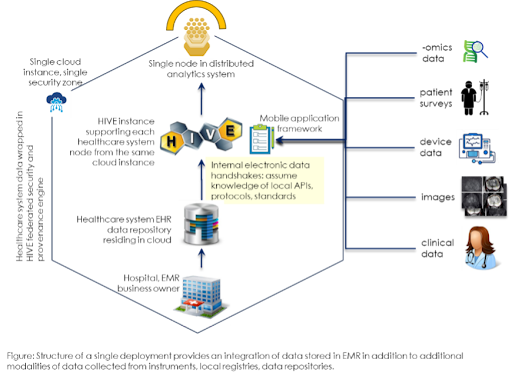
Research institutions, patient advocacy groups, and clinical societies utilize the HIVE platform to set up comprehensive registries with diverse data sources, such as clinical, patient-reported outcomes, imaging, genomics, and wearable datasets.
Examples of organizations using the HIVE platform include the Temporomandibular Joint Society, Lupus Research Alliance, The Aesthetic Society, Human Epilepsy Project, and FDA Medical Device Epidemiology Network (MDEpiNet).
Additionally, academic institutions such as George Washington University, Weill Cornell Medical Center, New York Presbyterian Hospital, Georgetown University, Johns Hopkins University, and Duke University use the HIVE platform.
HIVE technology is offered in various modes of deployment, including public HIVE instances in Amazon, Azure, and Google clouds, within institutional locally deployed computing clusters, and tailor-made HIVE-in-a-box appliances.
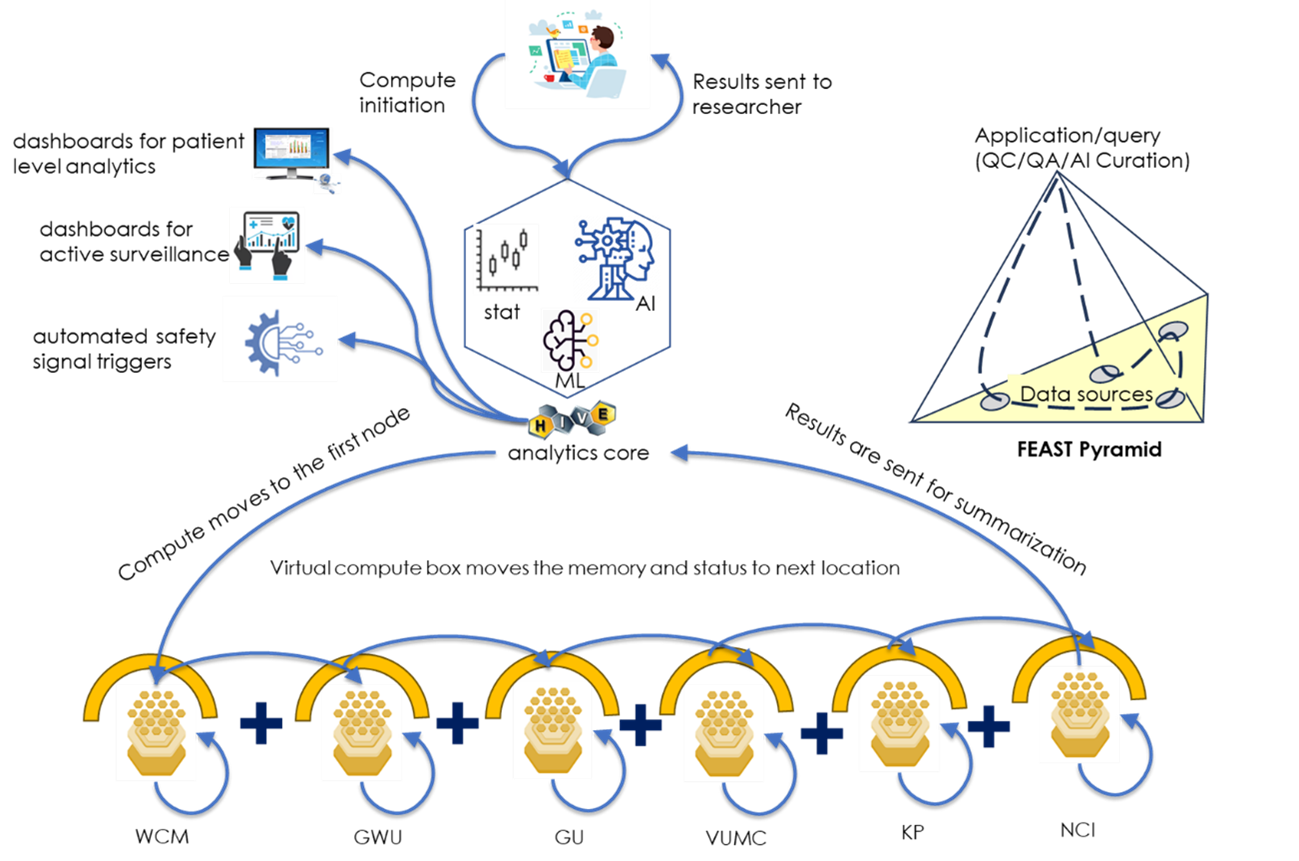
FEAST enables the analysis of datasets across different clinical systems and laboratories without moving data out of clinical systems, without violating HIPAA privacy rules, and maintaining the highest level of security. Biomedical and clinical data is fragmented, non-standardized, and moving linked data from multiple modalities to a central location for analysis poses prohibitive regulatory, cybersecurity, and privacy hurdles. FEAST addresses those challenges.
- Instead of moving data to algorithms in computation nodes, it moves algorithm to the data within different organizations.
- Instead of requesting data harmonization in different clinical systems, FEAST standardizes data on the fly.
- Instead of using open personal health information directly it uses dynamic encryption mechanisms and makes data visible only where the data belongs.
FEAST enables AI modules and bioinformatics tools to jump from site to site and use the data locally to develop robust models that are inclusive of large number of patients across different data modalities. This paradigm is called Motile Intelligence© (MI) and enables AI access to datasets in such scenarios where data is fragmented and not harmonized.